Boeing to Pay 32 Kenyan Families for 2019 Crash: The Numbers, the Law, and the Long Road to Compensation
Seven years after Ethiopian Airlines Flight 302 crashed on March 10, 2019, killing all 157 people on board, 32 Kenyan families are finally receiving a new wave of compensation from Boeing. Each family will receive approximately $2.73 million (about KSh 353.3 million), bringing the total payout for these households to roughly KSh 11.3 billion ($87.36 million) under this latest settlement.
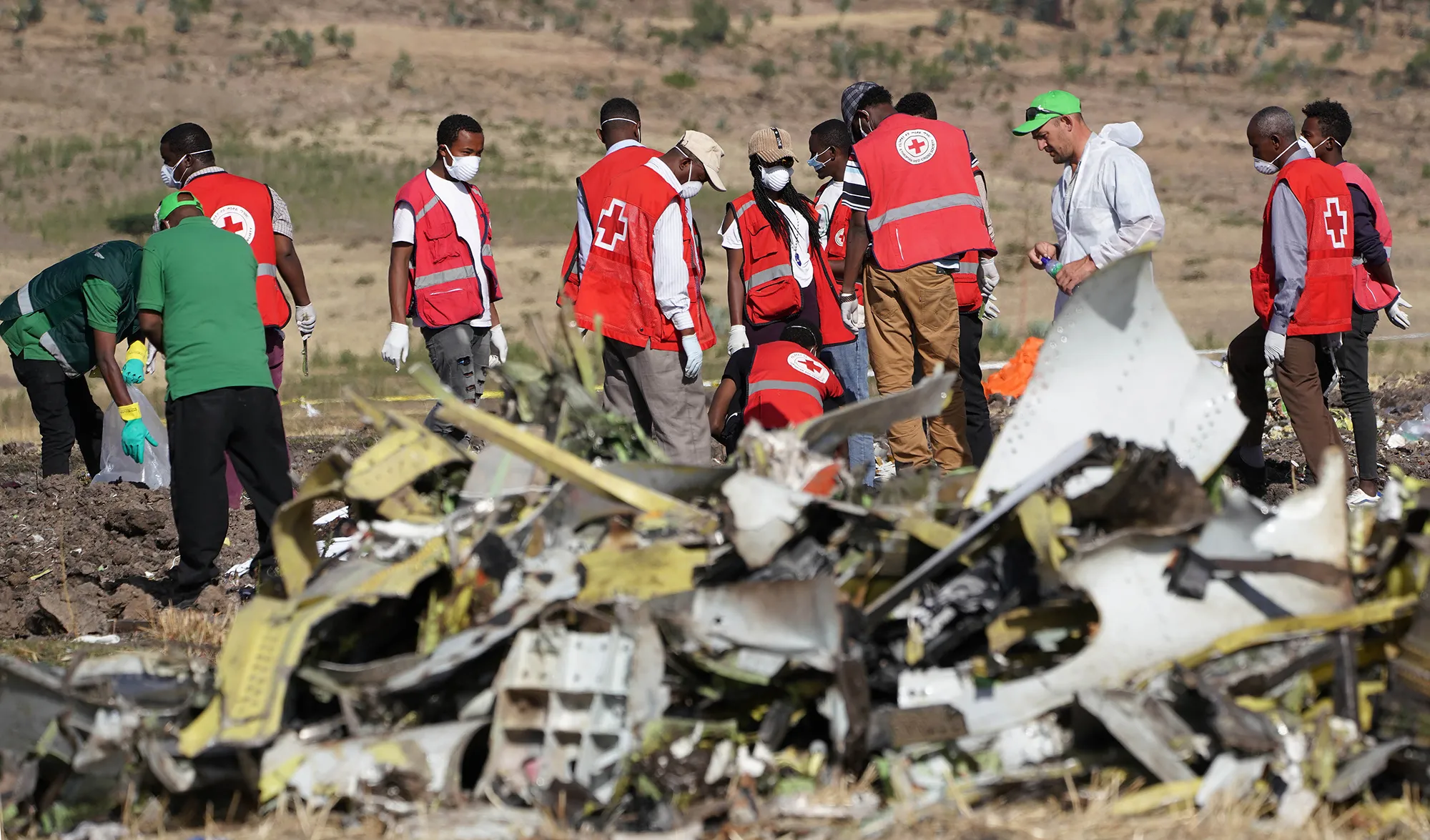
The Crash and Its Aftermath
Ethiopian Airlines Flight 302 was a Boeing 737 MAX 8 that departed Addis Ababa Bole International Airport bound for Nairobi’s Jomo Kenyatta International Airport. Six minutes after takeoff, the aircraft plunged into a field near Bishoftu, Ethiopia, killing 149 passengers and eight crew members from more than 30 countries. Kenya suffered the highest national toll: 32 Kenyan passport holders died, with four additional victims holding Kenyan ties but traveling on other or dual nationalities.nation+1
Investigators determined that a faulty angle-of-attack sensor triggered the aircraft’s Maneuvering Characteristics Augmentation System (MCAS), repeatedly forcing the nose down despite the pilots’ efforts to regain control. The disaster, coming just five months after the Lion Air Flight 610 crash in Indonesia (another 737 MAX 8), led to a 20-month worldwide grounding of the 737 MAX fleet and sweeping changes to software, pilot training, and certification processes. Kenyans
The Legal Battle: Two Tracks to Justice
Families of the victims pursued compensation through two parallel legal avenues: civil lawsuits in U.S. federal courts and a U.S. criminal case brought by the Department of Justice (DoJ) against Boeing. Nation
Civil Claims
Families filed civil suits in Chicago, where Boeing is headquartered, seeking damages for loss of income, companionship, suffering, and other harms. Many cases were settled confidentially, but some proceeded to trial. Notable jury awards include:
$49.5 million to the family of Samya Stumo (May 2026)
$28.45 million to the family of Shikha Garg (November 2025)
$29 million to the family of Micheál “Mick” Ryan (August 2026)
These verdicts signaled that juries were willing to assign substantial liability to Boeing for the design and certification failures that contributed to the crashes.
Criminal Case and the Non-Prosecution Agreement
In January 2021, Boeing entered a Deferred Prosecution Agreement (DPA) with the DoJ, agreeing to pay more than $2.5 billion, including a $500 million victim compensation fund for the 346 victims of the two 737 MAX crashes. Kenyan families began receiving payments from this fund by mid-2021, with each initially receiving about $1.45 million (KSh 187.7 million).
However, in May 2024, the DoJ determined Boeing had breached the DPA by failing to maintain an effective compliance and ethics program. After a proposed guilty-plea deal was rejected by a Texas judge in December 2024, a new Non-Prosecution Agreement (NPA) was finalized in May 2025. Under this agreement, Boeing avoided criminal prosecution but committed an additional $444.5 million to the victim compensation fund and $455 million to safety, quality, and compliance improvements, plus an independent compliance monitor.
Doing the Math: How the KSh 11.3 Billion Figure Is Derived
The latest compensation for the 32 Kenyan families comes from the additional $444.5 million victim fund established under the 2025 NPA. This fund is to be divided equally among all 346 victims of the two 737 MAX crashes (Lion Air and Ethiopian Airlines). Kenyans
Per-victim calculation:
$444.5 million / 346 victims ≈ $1.284 million per victim
However, reports state the average compensation per victim from this fund is approximately $2.73 million. This discrepancy arises because the $2.73 million figure represents the combined average from both the original 2021 victim fund ($500 million) and the 2025 additional fund ($444.5 million), totaling $944.5 million for 346 victims: Nation
$944.5 million / 346 victims ≈ $2.73 million per victim
Thus, each of the 32 Kenyan families receives $2.73 million from the combined criminal-case victim funds.the-star+1
Total for 32 families:
32×$2.73 million= $87.36 million
At current exchange rates (approximately KSh 129.4 per USD), this equals:
$87.36 million×129.4≈KSh 11.3 billion
Cumulative Compensation for Kenyan Families
This latest payout is not the first. Earlier, under the 2021 DPA, each family received about $1.45 million (KSh 187.7 million). Adding the new $2.73 million (KSh 353.3 million) brings the total per family to approximately: Nation
$1.45 million + $2.73 million = $4.18 million
KSh 187.7 million + KSh 353.3 million = KSh 541 million per family
For all 32 families, the cumulative total is:
32×KSh 541 million≈KSh 17.3 billion
Some families received even more through separate civil settlements or jury awards. For example, the first Kenyan family to settle (via Ribbeck Law) received $3 million (KSh 388.2 million) in December 2020, before the criminal-case funds were distributed. Nation
Broader Context: Boeing’s Total Financial Exposure
Boeing’s total financial commitments related to the 737 MAX crashes extend far beyond victim compensation. The 2021 DPA included:
$243.6 million criminal penalty.
$1.77 billion compensation to airline customers.
$500 million initial victim fund.
The 2025 NPA added:
$444.5 million additional victim fund.
$455 million for safety, quality, and compliance.
Cumulatively, the criminal-case victim funds now total nearly $944.5 million (KSh 122.6 billion). When combined with civil settlements, jury awards, customer compensation, and regulatory fines, Boeing’s total outlay exceeds $20 billion, according to public reports.
What This Means for the Families
For the 32 Kenyan households, this settlement marks the end of a grueling seven-year legal odyssey that spanned multiple jurisdictions and required coordination across more than 35 countries. The compensation, while substantial, cannot undo the loss of loved ones, but it provides financial security and a measure of accountability.
Consumer protection groups in Kenya have hailed the outcome as a landmark for international corporate accountability, while legal observers note the heavy reliance on U.S. courts underscores the need for stronger regional product liability laws. The-star
Final Thoughts
The Boeing 737 MAX tragedies reshaped aviation safety, regulatory oversight, and corporate accountability. For the 32 Kenyan families, the KSh 11.3 billion payout is both a conclusion and a beginning: the end of a long legal battle, and the start of a new chapter built on the memory of those lost.
Key figures at a glance:
Per family (latest): $2.73 million (KSh 353.3 million).
Total for 32 families (latest): $87.36 million (KSh 11.3 billion).
Cumulative per family (2021 + 2025 funds): ~$4.18 million (KSh 541 million).
Cumulative for 32 families: ~KSh 17.3 billion.
Total criminal-case victim funds: $944.5 million (KSh 122.6 billion)
Written by
Lawrence JLawrence John is the Founder and Editor of Africa Daily Dispatch, an independent digital publication focused on delivering timely, accurate and context-driven coverage of Africa and the wider world.
See more of our stories on Google
Add The Africa Daily Dispatch as a preferred source and we'll appear more often in your Top Stories.
Comments
Join the conversation.
Loading comments…