Not Charity, But Fair Finance: Sing’Oei’s Case for Rewriting Africa’s Place in Global Capital
Kenya’s Foreign Affairs Principal Secretary, Dr Abraham Korir Sing’Oei, has made a pointed argument to global policymakers: Africa does not need another round of benevolence. It needs a global financial system that prices African risk fairly, lends at affordable rates, and treats the continent as an investment destination rather than a permanent recipient of aid
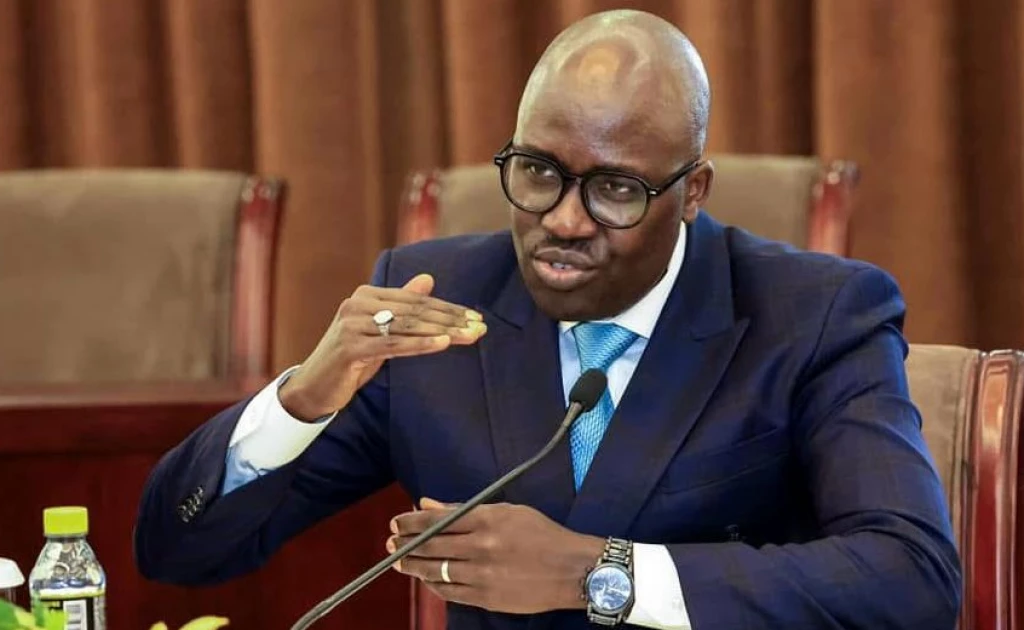
Speaking at Sciences Po in Paris, Sing’Oei framed Africa’s demand as one of equality, not exceptional treatment. His message was blunt: the continent’s economic transformation is being held back not by a lack of ambition or opportunity, but by inequalities embedded in the way international capital is allocated.
A continent at an inflection point
Sing’Oei described the present global moment as one of simultaneous crisis and opportunity. Countries are confronting climate shocks, debt pressures, pandemics and geopolitical conflict, even as technological change, global connectivity and a new generation of leaders create openings for cooperation.
For Africa, the stakes are particularly high. The continent is young, resource-rich and increasingly assertive in technology, culture, sport, energy and regional economic integration. Sing’Oei identified an “awakening,” an “African advantage” and greater African agency as forces reshaping the continent’s global posture.
He argued that Africa should no longer be defined mainly through narratives of poverty, conflict and underdevelopment. Instead, he said, the continent must be seen through its capabilities and future potential: a youthful population, green minerals, energy resources, blue-economy opportunities and the African Continental Free Trade Area, which is intended to create the world’s largest single market.
But that potential, Sing’Oei warned, cannot be realised if African governments and businesses continue to pay far more than their peers elsewhere to access capital.
The cost of being African
The central complaint is not that Africa lacks access to finance altogether. It is that the finance available is often too expensive, too short-term and too heavily conditioned by perceptions of risk that African leaders regard as exaggerated or biased.
According to figures Sing’Oei presented in Paris, African countries pay three to four times more to access capital than developed economies because of what he called biased risk pricing. He also said sovereign borrowing costs in Africa are capped at between 12 and 13 per cent, compared with 4 to 6 per cent in OECD countries.
He further stated that African borrowing costs rose by 91 per cent between 2020 and 2024, driven largely by currency volatility.
Those numbers matter because they translate directly into fewer schools, hospitals, roads, power plants and climate-resilient farms. When a government must devote a larger share of revenue to interest payments, it has less room to invest in productive sectors. When private firms face high lending rates, they create fewer jobs and scale more slowly.
Sing’Oei’s argument is therefore not simply a complaint about interest rates. It is a claim that the current system produces a structural disadvantage: Africa pays more to borrow, then has less capacity to grow, which in turn reinforces the very risk perceptions that make borrowing expensive.
Debt, development and lost sovereignty
The issue has become more urgent as debt-service burdens rise across the continent. At the sixth African Conference on Debt and Development in Nairobi, Sing’Oei said Africa pays about $90 billion annually in debt service, more than it receives in aid and climate finance combined.
He also cited an estimated $1.3 trillion annual financing requirement for Africa to achieve the Sustainable Development Goals. He said 22 African countries are in debt distress, while an “Africa risk premium” adds roughly $75 billion in additional interest payments each year.
Those figures, as reported from his remarks, illustrate why he describes debt as more than a balance-sheet problem. “This is not just a loss of finance, it is also a loss of sovereignty,” Sing’Oei said.
The sovereignty argument is important. A government forced to choose between servicing expensive debt and funding health, education or climate resilience is not fully free to set its own development priorities. In that sense, high borrowing costs can constrain democratic choices as much as external political pressure can.
A changed creditor landscape
Sing’Oei also argues that Africa’s debt diplomacy must adapt to a changed creditor environment. In the 1990s, he said, about 70 per cent of African debt was held through the Paris Club, largely involving Western donors. Today, he said, about 40 per cent is held by private bondholders in London, Hong Kong and Gulf financial centres.
That shift complicates debt restructuring. Instead of negotiating with a relatively identifiable group of official creditors, African states often face a fragmented set of public and private lenders with different incentives, legal claims and negotiating positions.
Zambia’s debt restructuring, which Sing’Oei cited as an example, reportedly took four years partly because China and the Paris Club could not agree. Whatever the precise causes in each case, the broader point is clear: slow restructuring can prolong uncertainty, restrict investment and deepen economic pain.
This is why Sing’Oei supports African countries using the Common African Position on Debt to negotiate collectively rather than approaching creditors one by one. His argument is that fragmented bargaining weakens the continent’s leverage, while coordinated positions could give African states more influence over the terms and pace of restructuring.
Reforming the rules, not asking for favours
Sing’Oei’s position is sometimes summarised as a call for “fairness,” but it has concrete policy implications.
First, he wants faster and more responsive debt restructuring. He has called for reforms to the G20 Common Framework so that countries facing debt distress can receive help before fiscal pressure becomes a full-blown crisis.
Second, he wants a rebalancing of risk assessment. He backs the establishment of an Africa Credit Rating Agency, arguing that Africa needs the capacity to assess its own sovereign risk rather than relying entirely on external rating institutions. “Africa needs to rewrite risk pricing by building her own capability to assess her own risk,” he said.
That proposal is not merely symbolic. Credit ratings influence the interest rates governments and companies pay, the willingness of investors to lend, and the cost of insurance and other financial products. If African institutions can produce credible, independent assessments, they could challenge risk premiums that Sing’Oei and other African policymakers view as excessive.
Third, he wants stronger African multilateral financial institutions. Rather than relying on institutions that must borrow externally and pass on high financing costs, Sing’Oei argues that Africa should capitalise its own institutions so they can lend on better terms.
Fourth, he supports a wider mix of financing instruments, including concessional finance, a better balance between debt and equity, and innovative tools such as debt-for-climate and debt-for-food swaps. But he also cautions that climate-finance arrangements must not become new forms of external control over national policy.
Climate finance cannot be an afterthought
The debt and climate agendas are inseparable in Sing’Oei’s argument. African countries are being asked to finance adaptation and green industrialisation while often borrowing at high cost in foreign currencies.
He has noted that Africa cannot build green industrialisation while borrowing at 12 per cent in dollars. He also said that although Africa has about 60 per cent of the world’s best solar resources, it receives only about 1 percent of green finance.
That mismatch goes to the heart of the fairness debate. Africa contributes relatively little to historical global emissions but faces severe climate impacts. If the continent must pay premium rates to borrow money for adaptation, renewable energy and resilient infrastructure, climate finance risks becoming another source of fiscal strain rather than a tool of shared responsibility.
Sing’Oei’s proposed response is to keep debt reform on the agendas of the African Union, European Union, UN climate negotiations, G20 and China-Africa engagements. He also wants climate finance designed in ways that support national ownership rather than undermining it.
Africa’s own responsibilities
Sing’Oei is not arguing that external reform alone will solve Africa’s financing problems. He has also stressed the need for African countries to raise more domestic revenue, ensure borrowed funds are used for their intended purposes, and strengthen the credibility of their own institutions.
That distinction matters. A call for fairer global finance is not a call for unlimited borrowing or a rejection of fiscal discipline. It is a demand that African governments be able to access capital on terms that allow them to invest productively, manage risk responsibly and avoid unnecessary austerity.
It also implies a broader agenda of economic statecraft: building deeper capital markets, improving tax systems, supporting regional payment systems, attracting investment into productive sectors and using AfCFTA to expand intra-African trade. Sing’Oei’s emphasis on African agency suggests that the continent’s negotiating power will depend not only on diplomacy, but also on its ability to present credible investment opportunities and manage public resources well.
A partnership of equals
In Paris, Sing’Oei pointed to Kenya’s relationship with France as an example of the kind of partnership he advocates: one based on mutual respect and shared interests rather than paternalism. He argued that modern diplomacy must go beyond government-to-government agreements to include human, technological and cultural connections capable of addressing shared challenges such as climate change and security.
That language reflects a wider shift in Kenya’s foreign policy. Sing’Oei has repeatedly linked Kenya’s diplomatic agenda to reform of the international financial and governance architecture, including at the United Nations, G20 and other multilateral forums. Kenya has positioned itself as an advocate for Africa’s collective voice on debt, climate finance, trade and global governance.
The underlying proposition is simple: Africa is not asking to be rescued. It is asking to be treated as a capable economic actor whose risks are assessed honestly, whose assets are recognised, and whose governments can borrow, invest and grow without being penalised by a system designed around other economies’ assumptions.
What fairness would look like
A fairer system, in practical terms, would include several changes:
Lower and more transparent borrowing costs for African sovereigns and firms.
Faster debt restructuring when countries face distress, rather than prolonged negotiations that deepen uncertainty.
Greater African participation in credit assessment and risk pricing, including credible African rating capacity.
Stronger, better-capitalised African financial institutions able to provide affordable development finance.
More concessional and equity-based financing, especially for climate adaptation and green industrialisation.
Coordinated African negotiation through mechanisms such as the Common African Position on Debt.
Climate finance that supports adaptation and energy transition without creating new debt traps or eroding policy sovereignty.
The wider significance
Sing’Oei’s intervention matters because it challenges a familiar development model in which Africa is cast as a beneficiary of Western generosity. His argument is that aid may still have a role in humanitarian emergencies or highly concessional contexts, but it cannot be the foundation of continental transformation.
Africa’s needs are too large, its opportunities too substantial and its demographic future too consequential for the continent to be financed mainly through charity. The question is whether global financial institutions, credit-rating systems, private investors and major economies are prepared to treat African risk and African opportunity with the same seriousness they apply elsewhere.
Sing’Oei’s answer is that they must. Otherwise, Africa will continue to possess the resources, markets and human capital needed for growth, while remaining locked out of the affordable capital required to turn those advantages into industries, jobs and resilient economies.
His message to the next generation of leaders was equally direct: the future of international relations will be shaped by deliberate choices, not fate. For Africa, the choice he is pressing is clear, move from a global financial order that offers sympathy to one that offers fairness.
Written by
Lawrence JLawrence John is the Founder and Editor of Africa Daily Dispatch, an independent digital publication focused on delivering timely, accurate and context-driven coverage of Africa and the wider world.
Comments
Join the conversation.
Loading comments…