Michael Carrick’s Hull Defeat Analysis: Manchester United’s Bigger Problem Is Turning Progress Into Results
Michael Carrick’s assessment of Manchester United’s defeat to Hull City was revealing because he refused to treat the result as the complete story.
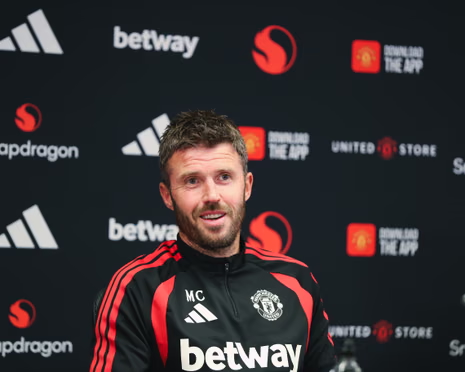
The Manchester United head coach acknowledged the obvious: United came to win, failed to do so, conceded two goals and left with the disappointment of a result that immediately puts pressure on the next fixture.
But Carrick also made an important distinction. In his view, elements of the performance reflected ideas that Manchester United have been developing during pre-season, even if those ideas were not consistently visible enough to influence the outcome.
That distinction may ultimately define how this United side develops.
The result exposed a gap between process and execution
Carrick repeatedly returned to the idea that some of Manchester United’s underlying work was present but not sufficiently effective.
His argument is not that United played well and were simply unlucky. He explicitly accepted that there was plenty to improve and that the team needed more of what it had been working on.
The more important issue is the gap between doing things correctly in training and executing them effectively when the competitive pressure arrives.
That is where today's defeat becomes useful as a diagnostic.
A football team can dominate possession, occupy the correct positions and demonstrate patterns rehearsed during the week. None of those things automatically produces goals.
The final test is whether those structures create chances, whether players make decisive decisions in the final third and whether the team remains sufficiently disciplined to prevent the opponent from scoring.
Against Hull, United did not reach that standard.
Carrick's comments therefore point toward a team still in the process of converting an intended style into a reliable competitive identity.
Two conceded goals changed the entire interpretation
Perhaps the most significant part of Carrick's assessment was his admission that the goals United conceded made the performance look considerably worse.
That is partly true because football is heavily influenced by decisive moments.
But there is another side to the argument.
If a team concedes two goals in a match it expected to win, those goals cannot simply be treated as unfortunate events that distort an otherwise encouraging performance. They are evidence of something that needs fixing.
Carrick acknowledged this himself.
The issue is therefore not whether the goals should be ignored because there were positive aspects to the performance. They should not.
The issue is whether United can identify why those moments happened and prevent them from becoming recurring patterns.
That is where the coaching staff now have their most important work.
Carrick's second-half changes provide one positive signal
United's second-half adjustments produced a more encouraging response, according to Carrick.
He explained that the coaching staff changed things because they needed to find a way back into the match. That is significant because it demonstrates that the team was not locked into one tactical approach regardless of circumstances.
But Carrick also acknowledged the danger of excessive changes.
When a team is losing and starts "chopping and changing", it can create opportunities but also disrupt the structure of the side.
That creates an important tactical balancing act for Manchester United.
A coach needs enough flexibility to respond when the original plan is not working, but enough structural stability to ensure that the response does not make the team even less coherent.
Today's match offered Carrick an early lesson in that balance.
The set-piece issue cannot be ignored
Although Bruno Fernandes addressed the problem more explicitly, Carrick's comments also sit within a broader defensive concern.
United conceded twice from set-piece situations.
That matters because set pieces are among the most repeatable situations in football. Unlike an unpredictable counter-attack or an individual moment of brilliance, defensive set pieces can be prepared, assigned and rehearsed repeatedly on the training ground.
The fact that Bruno admitted United knew teams would use set pieces as a strength makes the issue more significant.
Awareness existed.
Execution did not.
For Carrick, that should make the problem relatively straightforward to diagnose. The question is not whether United knew Hull represented a physical and aggressive threat. They did.
The question is why that preparation did not translate into sufficient defensive control.
Carrick's biggest challenge is preventing one defeat from becoming a pattern
The most interesting part of Carrick's interview came when he discussed the bigger picture.
He insisted that the defeat would not derail Manchester United's plans and pointed toward the Champions League draw, the first home match and the remaining transfer window.
That is sensible from a long-term perspective.
One match should not determine an entire season.
But there is a danger in relying too heavily on the bigger picture.
Football projects are ultimately judged through results. Carrick himself acknowledged that it is a results business.
That means the "bigger picture" only remains persuasive if improvement eventually becomes visible on the scoreboard.
The next few matches will therefore be important not because Manchester United must immediately erase every weakness, but because supporters need evidence that today's problems are being converted into lessons rather than repeated.
Ipswich now becomes more than just the next fixture
Carrick's reference to the upcoming home match against Ipswich was important.
The next game provides Manchester United with an immediate opportunity to demonstrate whether the response to Hull is genuinely different.
A convincing performance would not erase the defeat, but it could show that the team has learned from it.
Conversely, another flat display would increase questions about whether the problems Carrick identified are deeper than a single poor result.
That is the real significance of today's defeat.
Manchester United do not necessarily need to abandon what they have been building.
They need to make it more effective.
The challenge for Carrick is to turn encouraging elements from the training ground into competitive performances that produce goals, prevent avoidable concessions and, ultimately, collect points.
The Hull defeat does not destroy the bigger picture.
But it has made the weaknesses within that picture much easier to see.
Written by
Lawrence JLawrence John is the Founder and Editor of Africa Daily Dispatch, an independent digital publication focused on delivering timely, accurate and context-driven coverage of Africa and the wider world.
Comments
Join the conversation.
Loading comments…