Gachagua’s 2027 Bid: A Declaration, a Coalition Test, and the Opposition’s Make‑or‑Break Moment
Former Deputy President Rigathi Gachagua has moved from behind‑the‑scenes consultations to open campaign mode, declaring that Kenyans have urged him to run for president in 2027 and positioning himself as the opposition’s strongest option to unseat President William Ruto. The statement, delivered as he wrapped up a 55‑day “Wamunyoro” political conclave at his Nyeri home, is less a surprise than a calculated escalation in a crowded and fractious opposition field that is racing to agree on a single candidate before the next election cycle hardens.
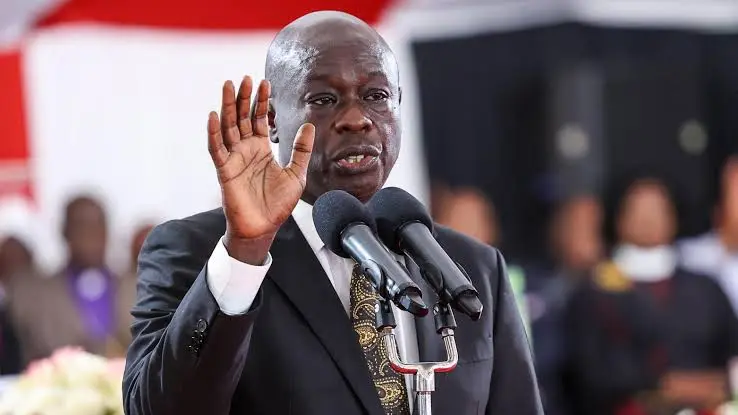
Gachagua framed his declaration as both a personal ambition and a mandate from the ground. He told reporters that after weeks of meetings with political leaders, professionals, religious figures, youth, women, elders and grassroots representatives, he was handed three clear tasks: hold the government to account, unite the opposition behind one presidential candidate, and persuade fellow opposition principals to back him for the presidency. On the third point, he was explicit: “Rigathi Gachagua shall be the preferred Presidential candidate of the United Alternative Government in the 2027 general election.”standardmedia
He also signaled a pragmatic fallback. While insisting he is the best bet, he said he would step aside if opposition leaders collectively agree another candidate has a higher probability of defeating Ruto, a line that attempts to balance confidence with coalition discipline. In a separate, more combative message, he added: “I am running for presidency. I am not a kingmaker; I am KING. I will not endorse anyone!” a reminder that he intends to be the headline act, not a supporting player.
The Wamunyoro conclave: consultation or campaign launch?
The 55‑day gathering at Wamunyoro functioned as an extended listening tour and a soft launch of a national pitch. Gachagua’s team says the consultations covered expectations for 2027, the state of the country, and the mechanics of building a viable alternative government. The timing matters: as other opposition principals convened to sign a “Personal Unity Pledge” promising to back a single candidate, Gachagua chose to host delegations at home and declare his own candidacy, effectively testing whether the coalition’s unity pledge can survive competing ambitions.
That dual track—coalition building at the Windsor Hotel while Gachagua holds court in Nyeri—captures the central tension in the opposition: the need for a unified front versus the gravitational pull of individual presidential projects.
Coalition math: United Alternative Government, Wiper, and the “cousins” angle
The opposition’s working umbrella, the United Alternative Government (UAG), has been trying to institutionalize unity through a secretariat and binding commitments. Within that framework, Gachagua’s Democracy for Citizens Party (DCP) has been courting a closer alignment with Kalonzo Musyoka’s Wiper Patriotic Front, with both sides publicly emphasizing a Mount Kenya–Ukambani partnership to prevent vote fragmentation. Deputy Governor Francis Mwangangi, leading a Wiper delegation to Nyeri, stressed that the two communities must work together to avoid splitting the opposition vote and to ensure Ruto does not secure a second term.tuko+3
However, reports of a exclusive Gachagua–Kalonzo “power deal” have been denied by Wiper, which insists it remains committed to a broad coalition rather than a bilateral arrangement. The denial does not erase the underlying logic: a DCP–Wiper axis could give Gachagua a national footprint beyond Mount Kenya while offering Kalonzo a refreshed pathway after years of near‑misses. Whether that axis becomes the coalition’s core or a competing pole will depend on the outcome of planned retreats and the strength of other contenders.
The field is crowded and impatient
Gachagua’s declaration lands in a marketplace of alternatives. Some allies and rivals have floated other names, including Nairobi Governor Edwin Sifuna, with calls for Gachagua to consider backing a candidate perceived as more nationally palatable. At the same time, polls and media narratives have highlighted Kalonzo as a leading opposition choice, adding pressure on Gachagua to prove his national appeal beyond his regional base.
The opposition’s impatience is visible in its rhetoric and scheduling. Principals have warned that time is short and have moved to create a coalition secretariat to coordinate strategy, even as they schedule “make or break” retreats to settle the flag‑bearer question. Gachagua’s insistence that he is the preferred candidate is therefore both a claim and a challenge: he is asking the coalition to ratify his bid or risk a public split.standardmedia+1
Strategy beyond Mount Kenya
A recurring critique of Gachagua has been that his politics are too Mount Kenya‑centric. His recent moves suggest an effort to shed that tag. He has announced plans to tour the country and the diaspora, arguing that he is marketing a national program under the DCP banner and seeking alliances beyond the region. The Wiper–DCP overtures are part of that same logic: a Mount Kenya–Ukambani bridge is intended to signal cross‑regional valiability.
Whether that translates into a first‑round win, as his supporters claim, will hinge on three factors: the cohesion of the opposition coalition, the credibility of his national message beyond economic accountability, and the ability to neutralize the incumbent’s advantages in state machinery and patronage.
Risks and opportunities
The biggest risk for Gachagua is a fractured opposition. If multiple strong candidates remain in the race, the anti‑Ruto vote could split, benefiting the incumbent. Conversely, if the coalition coalesces around him, he gains the organizational heft and regional breadth needed to compete nationally.standardmedia+2
His opportunity lies in the current mood for accountability and change. By casting himself as the candidate who can deliver a first‑round victory and by leveraging a DCP-Wiper partnership, he aims to present a clear, disciplined alternative to the Kenya Kwanza administration. The test now is whether the opposition’s unity structures can absorb his bid without breaking, and whether his national outreach convinces voters outside Mount Kenya that he is indeed their preferred option.
Bottom line
Gachagua’s declaration is real, timely, and strategically aimed at forcing the opposition’s hand. He has staked his claim as the UAG’s preferred candidate while leaving a narrow off‑ramp if the coalition insists on another name. The next few weeks, coalition retreats, secretariat operations, and further regional tours, will determine whether this becomes the opposition’s unifying moment or the start of a costly split.
Written by
Lawrence JLawrence John is the Founder and Editor of Africa Daily Dispatch, an independent digital publication focused on delivering timely, accurate and context-driven coverage of Africa and the wider world.
Comments
Join the conversation.
Loading comments…